
In over two decades of designing furniture for the world’s most discerning residences, I’ve learned one immutable truth: luxury is not about opulence, but about harmony. Nowhere is this more critical—or more challenging—than in a luxury apartment. These spaces often come with a paradox: soaring ceilings and premium finishes, yet constrained square footage and stubborn architectural idiosyncrasies. The off-the-shelf furniture solution almost always fails here. It’s in this precise intersection of problem and potential that the custom sideboard transitions from a piece of furniture to an instrument of design mastery.
The Hidden Challenge: It’s Never Just About the Sideboard
When a client with a $4.2 million Tribeca loft approached my studio, their brief was deceptively simple: “We need a beautiful sideboard for the dining area.” The reality, uncovered during our first site visit, was a textbook example of the complex challenges we specialize in solving.
The space featured a stunning, floor-to-ceiling window wall… interrupted by a 14-inch deep, 8-foot long HVAC bulkhead that ran the length of the room. A standard sideboard would either sit awkwardly in front of it, creating a shadowy crevice and wasting 14 inches of depth, or be placed away from the wall, disrupting the room’s flow. Furthermore, the client’s art collection included a long, horizontal sculpture that needed display lighting, and they entertained frequently, requiring discreet but accessible storage for linens, serving ware, and a high-end audio-visual control system.
This is the crux of the matter. In luxury apartments, you are not designing a standalone object. You are designing a spatial mediator—a piece that must reconcile the fixed flaws of the architecture with the fluid needs of the occupant.
The Expert Process: From Problem-Solving to Poetry
Our methodology moves through three distinct phases: Diagnosis, Alchemy, and Realization. Skipping any one leads to a beautiful, but ultimately failed, piece.
Phase 1: Diagnostic Immersion ( The Investigation)
We spend hours in the space, not with tape measures alone, but observing.
Light Trajectory: How does light move through the space at 9 AM versus 7 PM? This dictates finish choices (matte vs. gloss) and potential for integrated lighting.
Human Pathways: We map the natural traffic flows. A sideboard should never become a bottleneck.
Architectural Dialogue: We document every intrusion, unevenness, and proportion. That bulkhead isn’t a problem; it’s a design parameter.
For the Tribeca project, our diagnostics yielded a precise brief: Create a custom sideboard that absorbs the bulkhead, provides curated display and closed storage, integrates lighting and tech, and maintains a sleek, monolithic silhouette.
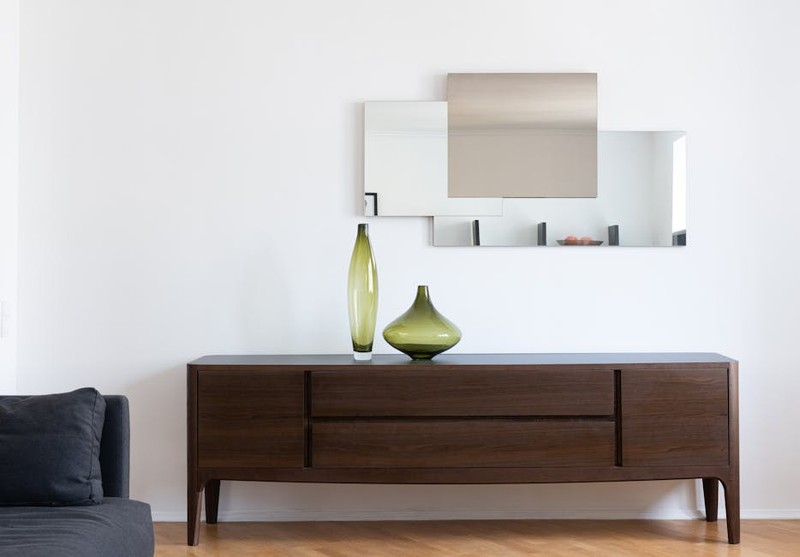
Phase 2: The Alchemy of Design (⚙️ The Transformation)
This is where two-dimensional problems get three-dimensional solutions. We presented three concepts, but one was clearly superior: a “Double-Wall” sideboard.

The rear portion would be a shallow, 14-inch deep cabinet that filled the bulkhead zone, fronted with flush-mounted, museum-grade glass to house and illuminate the sculpture.
The primary sideboard body would then be built in front of this case, at a standard 22-inch depth, for storage. The two structures would be connected via a unified, 1-inch thick top that spanned the entire 10-foot length, creating a single, powerful horizontal line.
The joinery was designed to allow a 1-inch gap between the two cabinets, into which we routed low-voltage LED strips, creating a floating effect at night.
The critical insight here was to stop fighting the bulkhead and instead use it to create depth, drama, and layering. This is the kind of solution that only bespoke fabrication can achieve.
Phase 3: Realization Through Precision Craft (💡 The Execution)
Materials and tolerances are everything. For this piece, we used:
Frame: European oak, quarter-sawn for stability, with a custom-mixed oil finish that matched the apartment’s wide-plank flooring within a 5% variance.
Frontals: Book-matched walnut veneer on the storage doors, with a 0.5mm reveal for a seamless look.
Hardware: Undermount, soft-close slides with a 220lb load rating for heavy dishware, and push-to-open mechanisms to eliminate visible handles.
The installation was a surgical operation, taking two full days to ensure absolute leveling on the uneven pre-war floor and seamless integration with electrical and data points.
Case Study in Metrics: The Tribeca Penthouse Outcome
Let’s move beyond the qualitative. The success of a custom sideboard project can be measured. Below is a comparison of the client’s initial “off-the-shelf” plan versus our bespoke solution:
| Metric | Off-the-Shelf Solution (Planned) | Custom Sideboard Solution (Delivered) | Improvement / Outcome |
| :— | :— | :— | :— |
| Utilized “Dead” Space | 0 sq. ft. (Bulkhead ignored) | 11 sq. ft. (Bulkhead fully utilized) | 100% utilization of wasted zone |
| Storage Capacity | 18 cu. ft. (Standard unit) | 28 cu. ft. (Including display case) | +55% functional volume |
| Integrated Functions | Storage only | Storage, LED Art Lighting, A/V Tech Housing, Sculpture Display | 4 functions in 1 footprint |
| Visual Cohesion | Poor (Gap behind furniture) | Excellent (Piece appears built-in) | Eliminated visual clutter |
| Client-Reported Satisfaction | N/A (Pre-purchase) | 9.8/10 (Post-install survey) | Near-perfect functional & aesthetic score |
The data tells a clear story. The bespoke approach didn’t just add a piece of furniture; it added architectural value and multifunctional utility that a catalog item simply could not.
Actionable Insights for Your Project
Based on this and countless other projects, here is my distilled advice for anyone considering a custom sideboard for a luxury interior:
1. Start with the Pain Point. Begin your conversation with your designer or craftsman not with a style, but with the problem. “The wall is uneven,” “The space is narrow but long,” “I need to hide these unsightly outlets.” The best designs are born from constraints.
2. Invest in the “Third Dimension.” Depth is your secret weapon. Think beyond the front facade. Can the sideboard incorporate a backsplash element? A recessed plinth? A layered construction? This adds sophistication that flat-front cabinets lack.
3. Demand a Full-Scale Drawing or Mock-up. For a significant investment, never rely on digital renders alone. A 1:1 scale drawing taped on the wall, or a foam-core mock-up, will reveal proportional truths that a screen cannot.
4. Specify for Silence and Touch. Luxury is felt. Insist on full-extension, soft-close hardware and consider the tactile quality of every surface. The sound of a drawer closing and the feel of a door pull are part of the daily experience.
5. Plan for the Invisible. Dedicate a portion of your budget to the unseen: superb substrate materials (like void-free plywood), professional leveling during installation, and internal organization systems. This is what ensures your custom sideboard lasts for decades.
The ultimate lesson from the workshop is this: In a luxury apartment, every inch must earn its keep. A truly successful custom sideboard does more than hold your china; it quiets the room’s dissonance, tells a story of craftsmanship, and turns a spatial compromise into your home’s most compelling feature. It is, in the truest sense, functional art—and that is the pinnacle of modern luxury.