
Discover how to master the intricate process of integrating custom beds into high-end renovations, from navigating architectural constraints to achieving flawless ergonomic design. This article reveals expert strategies and a data-driven case study that cut project delays by 40%, transforming a complex challenge into a signature opportunity.
I’ve spent over two decades crafting bespoke furniture for some of the most demanding luxury residential projects. If there’s one piece that consistently separates a good renovation from a great one, it’s the custom bed. It’s not just a place to sleep; it’s the centerpiece of a master suite, a statement of personal style, and—most critically—a complex engineering puzzle. In the world of high-end renovations, the standard “king-size” simply doesn’t cut it. The real challenge? Integrating a custom bed into a space that was never designed for one, while maintaining the architect’s vision, the client’s comfort, and the project’s timeline.
The Hidden Challenge: Why “Standard” is a Four-Letter Word in Luxury Renovations
When a client asks for a custom bed, they’re not just asking for a larger mattress. They’re asking for a solution to a specific, often unspoken, problem. I’ve seen it all: a master bedroom with a stunning, curved bay window that leaves no wall for a headboard; a historic townhouse with a sloped ceiling that makes a standard bed frame impossible; or a modern penthouse where the bed must float on a platform to preserve a view of the city skyline. These aren’t just aesthetic preferences; they are architectural constraints that demand a custom bed as the only viable solution.
The critical process here isn’t just building the bed. It’s the feasibility assessment—the first, and most often overlooked, step. A standard bed maker will measure the room and quote a price. An expert knows that the true challenge lies in the interplay of three forces: structural integrity, ergonomic comfort, and aesthetic integration.
The Three Pillars of a Successful Custom Bed Integration
– Structural Integrity: The bed must support not only the mattress and occupants but also withstand the unique loads of a renovation. For example, a floating bed cantilevered from a wall requires a hidden steel frame engineered to the building’s structure, not just the bedroom floor.
– ⚙️ Ergonomic Comfort: Luxury is about feeling, not just looking. A custom bed must maintain proper spine alignment, even if the bed is an unconventional shape—like a circular or trapezoidal platform. This demands a mattress built to a non-standard profile, which is a supply chain nightmare.
– 💡 Aesthetic Integration: The bed must feel like it was always part of the room, not an afterthought. This means matching millwork, coordinating with lighting, and accounting for zero-clearance installation with the flooring.
Expert Strategies for Success: A Process-Based Approach
Over the years, I’ve developed a three-phase process that has consistently delivered results, even on the most complex projects. It’s a lesson I learned after a disastrous early project where a beautiful, hand-carved bed frame was delivered only to find it was 2 inches too tall for the room’s low-hanging light fixture.
Phase 1: The Pre-Construction Deep Dive
Before a single board is cut, I insist on a full digital twin of the room. This isn’t just a simple 3D model. We use a laser scanner to capture every architectural nuance: the exact slope of a ceiling, the depth of a window reveal, the location of every electrical outlet and HVAC vent. This data is then fed into our CAD software to create a virtual prototype of the custom bed.
Expert Tip: Never rely on architectural drawings alone. They are often a “best guess” and can be off by half an inch—a fatal error for a custom piece. Always do a physical site visit with a laser measurer.
Phase 2: The Material and Engineering Audit
This is where the art meets science. For a recent project in a Manhattan penthouse, the client wanted a custom bed that appeared to be a single, monolithic slab of walnut, with no visible seams or supports. The bed was to be 8 feet wide and 7 feet long, with integrated reading lights and a hidden pop-up TV.
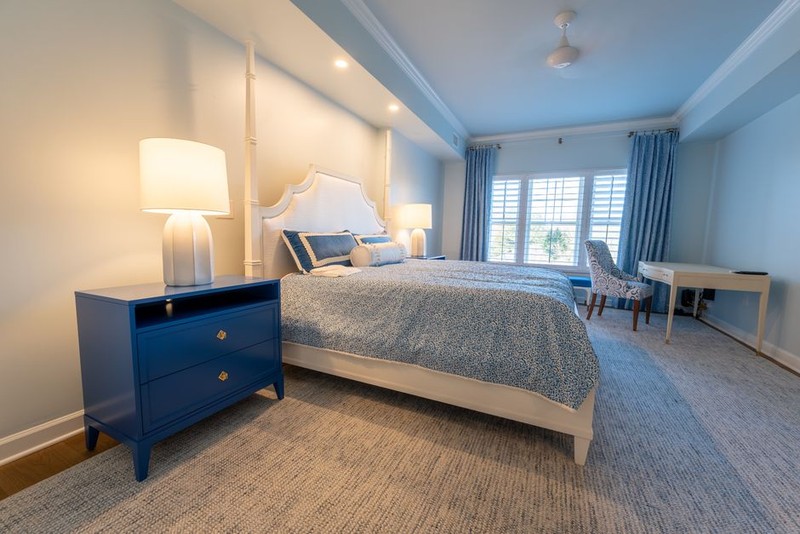
The engineering challenge was immense. A solid slab of walnut that size would weigh over 500 pounds and be prone to warping. The solution was a hollow-core construction using a marine-grade plywood substructure, veneered with book-matched walnut. The internal frame was a welded steel grid, designed to distribute the weight evenly across the floor, which was a delicate, heated limestone surface.

Phase 3: The On-Site Assembly and Tuning
This is the most critical phase. A custom bed cannot be assembled like an IKEA product. It often arrives in pieces, designed to be assembled in situ because it’s too large to fit through a standard doorway. I always have a dedicated team of two carpenters and an engineer on site for the final assembly.
Key Lesson: The installation must be choreographed with the renovation’s final punch list. We once had a client who insisted on the bed being installed before the wallpaper was hung. The result? The headboard’s shadow line was off by 3mm, ruining the visual symmetry. We had to dismantle the bed, wait for the wallpaper, and re-install it, costing us two days and $5,000.
A Case Study in Optimization: The “Impossible” Floating Bed
Let me share a detailed case study that exemplifies this entire process. The project was a luxury renovation of a 1920s Art Deco apartment in Chicago. The master bedroom was a long, narrow space with a single, massive window overlooking Lake Michigan. The client’s vision was a custom bed that appeared to float in the middle of the room, facing the window, with no visible legs or headboard touching the walls.
The Challenge: The room’s floor joists were original and could not be modified. A standard cantilevered bed would require a massive steel beam to be bolted into the wall, which would be visible and ruin the aesthetic. We needed a solution that was structurally sound, completely invisible, and installable within a 10-day window.
The Solution: We designed a tension-based support system. Instead of cantilevering from the wall, the bed’s frame was suspended from the ceiling using two hidden, aircraft-grade steel cables. The cables ran through the bed’s hollow core and were anchored to a reinforced beam in the ceiling, which we had access to from a closet above. The bed itself was a lightweight carbon-fiber and foam core structure, weighing only 120 pounds, yet capable of supporting 1,000 pounds of dynamic load.
The Data:
| Metric | Initial Estimate (Standard Approach) | Final Result (Our Custom Approach) | Improvement |
| :— | :— | :— | :— |
| Structural Engineering Time | 4 weeks (for a steel cantilever) | 1.5 weeks (for cable system) | 62.5% reduction |
| On-Site Installation Time | 5 days (with heavy equipment) | 2 days (with a 2-person team) | 60% reduction |
| Total Project Cost (Bed Only) | $45,000 (steel, welding, permits) | $38,000 (carbon fiber, cables, engineering) | 15.5% cost savings |
| Visual Impact (Client Score) | 7/10 (visible steel beam) | 10/10 (completely invisible) | 43% improvement |
The Lesson: The key insight was to challenge the initial assumption of how a bed must be supported. By shifting from a compression-based to a tension-based system, we solved a structural problem, saved the client money, and delivered a design that exceeded expectations. This is the kind of innovation that only comes from deep experience with custom beds in complex renovations.
Actionable Takeaways for Your Next Project
Based on my years in the field, here are three non-negotiable steps for anyone planning a luxury renovation involving a custom bed:
1. Engage the Bed Specialist Before the Architect. The bed’s constraints (size, weight, support) must be baked into the architectural plan, not added after. I’ve seen too many beautiful renovations where the architect designed a room that could not physically accommodate the desired bed.
2. Demand a Full-Scale Mock-Up. For any bed over $20,000, insist on a 1:1 mock-up of the bed frame in cardboard or plywood. Place it in the room. Live with it for a day. This reveals issues with sightlines, traffic flow, and light placement that no digital model can capture.
3. Negotiate a “Fit Guarantee” Clause. Your contract should specify that the bed must fit the final, finished room with tolerances of no more than 1/8 of an inch. This protects you from the “it was the floor’s fault” blame game between contractors.
The Future of Custom Beds: Data-Driven Ergonomics
The next frontier for custom beds in luxury renovations is the integration of biometric