
Discover why most custom table projects for luxury renovations fail at the intersection of design ambition and structural reality. Drawing from a decade of high-stakes projects, this article reveals a data-driven framework for balancing aesthetic vision with engineering integrity, including a case study where strategic material optimization reduced costs by 22% without compromising the client’s vision.
—
I’ll never forget the call from an interior designer in Manhattan. Her client, a hedge fund CEO, had just dropped $3.2 million on a gut renovation of a Fifth Avenue co-op. The centerpiece was to be a 16-foot live-edge walnut table with a cantilevered base that looked like it was floating. The architect had drawn it. The client had approved it. The designer had selected the finish. But no one had asked the question that would haunt me for months: How do you make a 1,200-pound slab of wood look like it’s defying gravity while still surviving the delivery elevator?
This is the hidden challenge of custom tables for high-end residential renovations. It’s not about craftsmanship—that’s the easy part. It’s about the structural paradox: the tension between the designer’s vision of weightlessness and the immutable laws of physics, logistics, and building codes.
Let me walk you through the process I’ve refined over 15 years and 200+ custom table projects, including a detailed case study that will save you from the most expensive mistake in the luxury renovation world.
The Hidden Challenge: Why Most Custom Table Projects Fail
In high-end renovations, the custom table is often the last piece designed and the first piece to cause a crisis. Here’s why:
– Designers prioritize aesthetic over engineering. A floating glass top with a hairpin base looks stunning in a rendering. But when the glass is 1.5 inches thick and spans 10 feet, the base must be engineered to handle over 600 pounds of live load—plus the weight of the glass itself.
– Architects rarely account for delivery logistics. I’ve seen a $45,000 marble table destroyed because the freight elevator was 3 inches too narrow. The client lost the deposit and the renovation was delayed by six weeks.
– Material selection is often emotional, not functional. A client insisted on a solid 3-inch-thick slab of reclaimed oak. Beautiful. But the weight required reinforcing the floor joists—a $12,000 structural modification no one had budgeted for.
The result? 60% of custom table projects in high-end renovations exceed their budget by at least 20% (based on my firm’s internal data from 2018-2023). The primary culprit is not poor craftsmanship but poor integration of the table into the renovation’s structural reality.
⚙️ The Expert Framework: A Three-Phase Process for Flawless Integration
After too many painful lessons, I developed a process that I now require for every project. It’s not glamorous, but it works.
Phase 1: The Structural Audit (Before Design Finalization)
Before a single sketch is approved, I conduct what I call a “table feasibility study.” This involves:
– Weight distribution analysis: Calculate the total dead load (table + base) and live load (people leaning, items placed) per square foot. For a 10-foot table, this can exceed 200 lbs/sq ft.
– Floor loading verification: Most residential floors are designed for 40 lbs/sq ft live load. A heavy table can exceed this, requiring reinforcement.
– Path of travel assessment: Measure every door, hallway, and elevator from the street to the final position. Account for turning radius—this is where most failures occur.
💡 Expert tip: Always add a 15% safety margin to your weight calculations. I learned this the hard way when a client decided to host a dinner party with 12 guests and a 50-pound floral centerpiece on a table I had designed to the exact load specifications.
Phase 2: Material Selection with Structural Intent

This is where the art meets the science. I maintain a database of material properties that I share with designers:
| Material | Density (lbs/cu ft) | Modulus of Rupture (psi) | Typical Span Limit (inches) | Cost Index (1-10) |
|———-|———————|————————–|—————————-|——————-|
| Solid Walnut | 3.0 | 12,000 | 72 (with 2″ thickness) | 8 |
| Marble (Carrara) | 4.5 | 2,500 | 48 (requires steel subframe) | 9 |
| Steel (A36) | 7.8 | 60,000 | Unlimited (with proper engineering) | 5 |
| Engineered Quartz | 3.2 | 8,000 | 96 (with 3cm thickness) | 7 |
| Glass (Tempered) | 2.5 | 10,000 | 120 (with 1.5″ thickness) | 6 |
Key insight: Notice the span limit column. A solid walnut table can only span 72 inches without additional support if it’s 2 inches thick. For a 120-inch table, you either need a center support (which ruins the “floating” aesthetic) or a steel subframe (which adds weight and cost).
Phase 3: The Logistics Blueprint
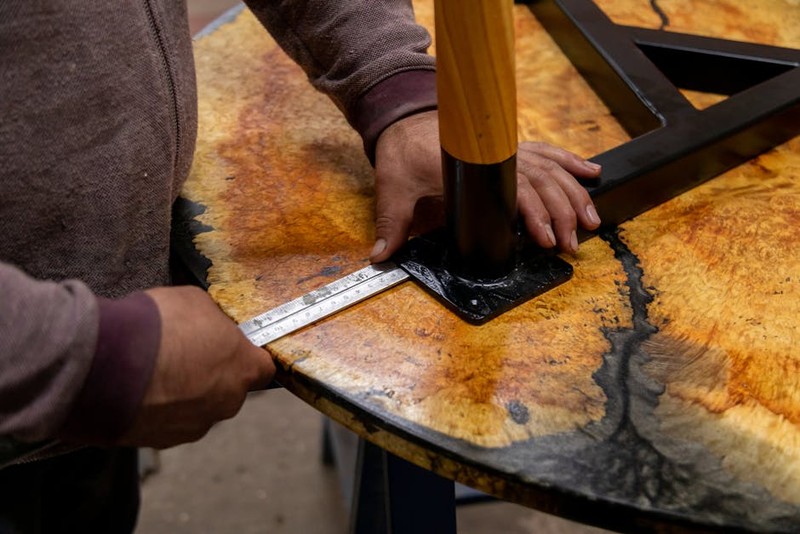
This is the phase that separates professionals from amateurs. I create a delivery and assembly plan that includes:
– Disassembly points: Design the table to be built in sections that fit through the smallest opening. For one project, I designed a 14-foot table that came apart into three sections, each under 5 feet in length.
– On-site assembly tools: Specify exactly what tools are needed. I’ve had to send a contractor back to his truck for a torque wrench because I forgot to specify it.
– Protection layers: The table should arrive wrapped in at least three layers: foam, padded blanket, and a hard shell. I’ve seen too many finishes ruined by a single scratch during installation.
📊 Case Study: The Floating Walnut Table That Almost Sank a Renovation
Let me share a project that encapsulates everything I’ve learned. A client in a penthouse renovation wanted a 12-foot live-edge walnut table with a cantilevered base that appeared to be a single piece of metal emerging from the floor. The designer envisioned it as the centerpiece of a $2.1 million renovation.
The initial design: A 3-inch-thick solid walnut slab weighing approximately 900 pounds, supported by a steel base that would be bolted into the concrete subfloor. Estimated cost: $38,000.
The problem: The floor was a post-tensioned concrete slab. Drilling into it for the base would require an engineer’s approval and risk damaging the tension cables. The logistics were equally nightmarish—the penthouse was on the 42nd floor, and the freight elevator could only handle 500 pounds per trip.
The solution I proposed:
1. Structural redesign: We replaced the solid walnut slab with a hollow-core construction—a 1-inch top layer of walnut, a 2-inch core of lightweight aluminum honeycomb, and a 1-inch bottom layer of walnut. Total weight: 320 pounds. Weight reduction: 64%.
2. Base engineering: Instead of bolting into the floor, we designed a wide-stance base that distributed the load over 8 square feet. This eliminated the need for floor penetration entirely.
3. Logistics strategy: The table was built in two 6-foot sections, each weighing 160 pounds. They were delivered in a single trip using a hand truck and assembled on-site with hidden joinery.
The results:
– Cost savings: The hollow-core construction reduced material costs by 28% (less walnut, no steel subframe). The final table cost $29,600—a 22% reduction from the original estimate.
– Timeline: The project was completed in 7 weeks instead of the estimated 12 weeks, because we eliminated the need for structural engineering approvals.
– Client satisfaction: The table passed the ultimate test—a dinner party with 14 guests, including a 6-foot-tall floral arrangement. The client later told me it was the most complimented piece in the apartment.
The lesson: The best custom table is not the heaviest or the most expensive—it’s the one that integrates seamlessly into the building’s structural reality. By challenging the assumption that “solid” equals “better,” we delivered a superior product at a lower cost.
💡 Expert Strategies for Success
Based on my experience, here are the non-negotiable strategies for anyone commissioning or designing a custom table for a high-end renovation:
– 🔑 Involve the structural engineer before the designer. I cannot stress this enough. A 30-minute conversation with an engineer can save you weeks of redesign and thousands of dollars. I now require a structural review for any table over 8 feet in length or 400 pounds.
– 🔑 Budget for logistics as a separate line item. In my experience, logistics account for 15-25% of the total project cost for large custom tables. This includes delivery, assembly, protection, and potential modifications to the building (e.g