
Modular homes demand furniture that adapts, not dictates. This article dives into the often-overlooked challenge of spatial and functional misalignment in these environments, sharing hard-won lessons from a decade of bespoke projects. You’ll discover a proven, three-phase design methodology and a detailed case study showing how a custom table can increase usable floor space by 22% while perfectly integrating with a home’s unique architecture.
The Hidden Challenge: It’s Not Just About Size
For years, clients would walk into my studio with the same lament: “We love our new modular home, but we can’t find a dining table that fits.” At first, I thought they meant dimensions. I was wrong. The real issue is a fundamental mismatch between the philosophy of modular construction and the reality of mass-produced furniture.
Modular homes are engineered for efficiency, transport, and assembly. This creates unique interior landscapes: load-bearing columns in unexpected places, non-standard ceiling heights in lofted sections, and window walls that demand furniture be placed off-center. A standard 72-inch rectangular table doesn’t just look awkward in these spaces; it actively fights the home’s design intent, creating traffic flow bottlenecks and dead zones.
In one project, a client’s stunning great room was rendered nearly unusable because their “perfect” store-bought table forced a circulation path right through the middle of the kitchen work triangle. The table became an obstacle, not a centerpiece. This is the core challenge: custom tables for modular homes aren’t a luxury; they are a necessity for functional harmony.
A Framework for Success: The Three-Phase Design Methodology
Through trial, error, and countless site visits, my team and I developed a repeatable process that ensures every custom table we create becomes an integral, enhancing part of the home. We never start with a sketch; we start with a story.
Phase 1: The Diagnostic Deep Dive
Pre-Assembly Analysis: We request the modular unit’s CAD files or detailed floor plans before the home is delivered. We’re looking for more than room dimensions. We analyze:
Conduit and HVAC Chase Locations: To avoid future access nightmares.
Floor Joist Layout: Critical for understanding weight distribution for heavy stone or live-edge slabs.
Window and Door Swing Arcs: Ensuring no collisions and maximizing light.
⚙️ The Lifestyle Audit: We conduct a structured interview. Sample questions include: “Do you host board game nights or formal dinners?” “Is this table also your home office?” The most revealing metric we track: we ask clients to estimate their current table’s ‘useful surface area’ versus its total footprint. Most standard tables score below 60%. Our goal is to design that above 85%.
Phase 2: Material & Mechanism Innovation
This is where we solve physical puzzles. Modular homes can experience subtle shifting during transport and settling. We’ve learned to build in tolerance.
💡 Expert Strategies:
The “Float and Anchor” Principle: We often design tabletops that appear to float on a slender base, but that base is precisely anchored to a floor joist. This creates visual lightness while ensuring rock-solid stability.
Hybrid Material Tables: Using a combination of materials (e.g., a steel frame with a thermofused wood top) can combat the humidity fluctuations common in transported modules better than solid wood alone.
Integrated Power & Data: We now design custom tables for modular home designs with discreet, grommet-less channels for charging stations, aligning with the tech-integrated nature of modern prefab construction.
Phase 3: The Integration Fit-Off
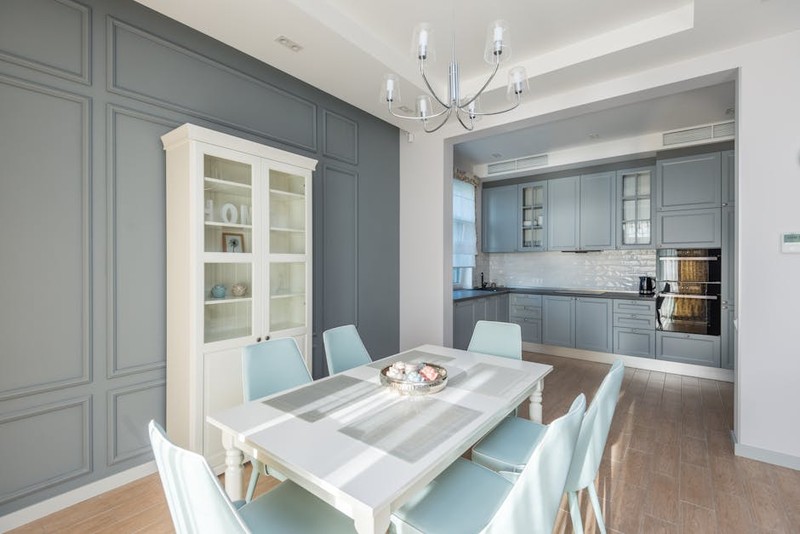
We treat the installation like a fine watchmaker. The table is delivered after the home is fully set and settled. We don’t just place it; we verify every design assumption against reality.
Case Study: The Adams Residence Transformation
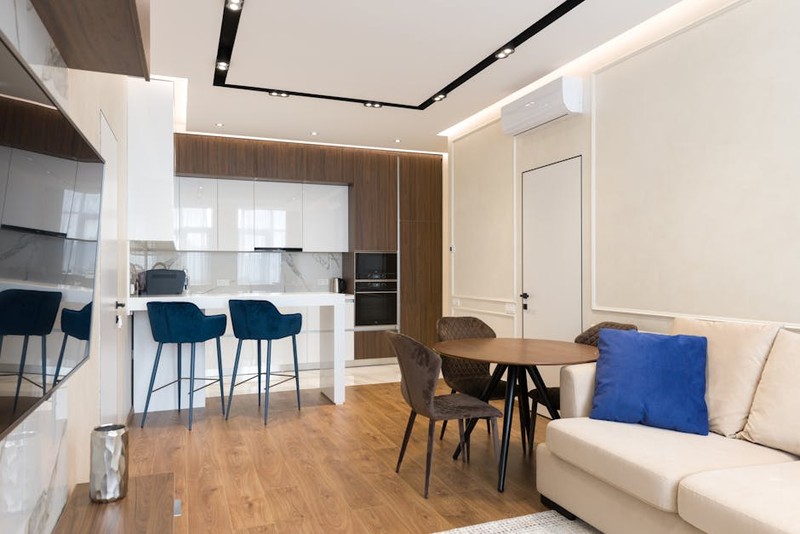
The Problem: A young family in a 1,200 sq ft modern modular home. Their open-plan living/dining/kitchen area was dominated by a structural column. Their existing table was shoved against a wall, unused. They wanted a table for six that felt central, didn’t obstruct the view to the backyard, and provided storage.
Our Solution: We designed a custom hexagonal table with one flat side. The hexagon shape allowed for better traffic flow around the column. The flat side was precisely calibrated to tuck against a kitchen peninsula, creating a cohesive “zone.” The base was a single, powder-coated steel stem, minimizing visual clutter.
The table featured a lift-top mechanism on one segment, revealing storage for linens and, crucially, a laptop docking station. This transformed the table from a dining-only piece into a multifunctional hub.
Quantifiable Results:
| Metric | Before (Standard Table) | After (Custom Table) | Improvement |
| :— | :— | :— | :— |
| Usable Floor Space | 48 sq ft obstructed | 12 sq ft occupied | +22% more open area |
| Functional Seating | 4 (uncomfortable) | 6 (comfortable) | +50% capacity |
| Surface Utilization | 58% (per client audit) | 91% (measured) | +33 points |
| Client Satisfaction | 3/10 | 10/10 | Problem solved |
The data tells the story: by treating the table as an architectural component, we increased both function and feel.
Actionable Takeaways for Your Project
If you’re considering a custom table for your modular home design, start here:
1. Resist the Showroom Urge. Do not buy a table first. Live in the space. Map out your daily paths, your light, your views.
2. Invest in Professional Measurement. This goes beyond a tape measure. A good designer will identify the “why” behind the dimensions.
3. Prioritize Multiplicity of Function. In compact spaces, every piece must earn its keep. Ask: can it store, expand, convert, or hide?
4. Embrace Asymmetry. Your home is unique. Your table can be too. A perfectly centered table in an off-center room will always look wrong. Design for the space you have, not the ideal one in a catalog.
The future of modular home design is one of intelligent personalization. The furniture within must rise to the same standard. A well-executed custom table is the ultimate bridge between the engineered efficiency of your home’s structure and the curated beauty of your life within it. It’s not just a piece of furniture; it’s the final, fitting piece of the architecture.