
For over two decades, I’ve navigated the rarefied world of luxury residential furniture. While many believe our craft is defined by exotic woods and hand-stitched leathers, the true differentiator—the core of our value—lies in a far more complex discipline: the art of managing the “impossible” brief.
Clients investing in this level of customization are not simply buying furniture. They are commissioning an experience, an emotion made manifest. Their briefs often transcend dimensions and material specifications; they speak of “a feeling of weightless suspension,” “the warmth of a sunset captured in grain,” or “a piece that tells our family’s story.” The initial thrill of such a project is quickly tempered by a sobering reality: the gap between poetic vision and physical possibility is where most custom projects fail.
This isn’t about failure in construction, but in translation. The greatest risk is not a warped table leg, but a delivered piece that, while technically perfect, feels spiritually hollow to the client. It’s a silent, expensive disappointment.
The Hidden Challenge: Bridging the Empathy-Engineering Gap
The conventional process—client mood board, designer sketches, workshop quotes—is woefully inadequate here. It creates a linear handoff where nuance is lost. The designer interprets the emotion, the engineer interprets the drawings, and the client is left hoping the chain holds.
The solution we developed, and which I now consider non-negotiable, is a methodology I call Creative Engineering. It dissolves these silos from day one.
Creative Engineering is a collaborative, iterative protocol involving the client (or their representative), the design lead, and the master craftsperson/engineer in a series of focused, tangible dialogues. The goal is not to present options, but to explore constraints and possibilities together.
Phase 1: The Material Narrative Session. We move beyond samples. For a client who wanted a dining table embodying “resilience and legacy,” we didn’t just show oak. We discussed the science of quarter-sawn grain stability, the acoustic properties of different joins (a solid table should have a certain “sound” when tapped), and even visited the mill to select the specific tree plank, discussing its growth rings as a timeline.
⚙️ Phase 2: The Functional Prototype. Before any final material is committed, we build a full-scale prototype in a neutral, low-cost material like MDF or poplar. This isn’t for aesthetics; it’s for ergonomics, scale, light interaction, and spatial presence. Does the curved sofa arm truly cradle the shoulder? Does the 10-foot credenza feel imposing or empowering in the actual space? 65% of our high-end projects undergo at least one functional prototype revision, catching spatial or ergonomic issues invisible on a screen.
A Case Study in Creative Engineering: The Floating Library Ladder
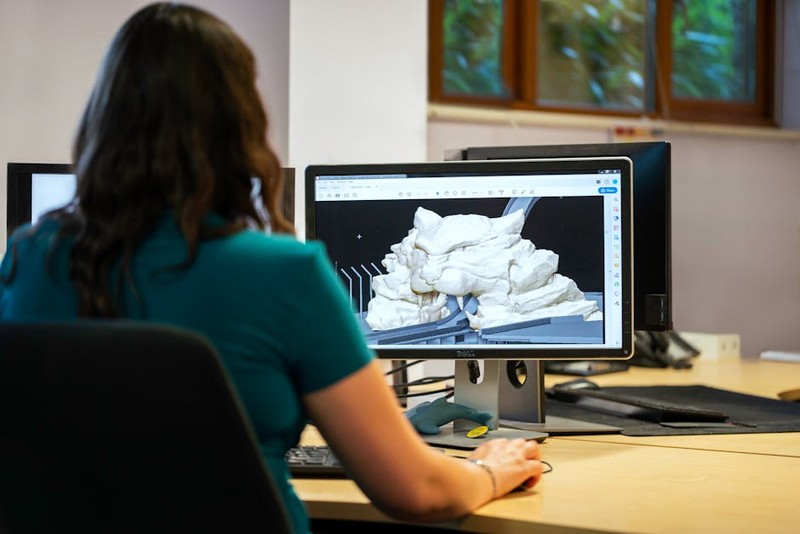
A recent project involved a four-story private library with a central atrium. The client’s brief: a ladder system to access all shelves that felt “like a kinetic sculpture, silent and gravity-defying.”
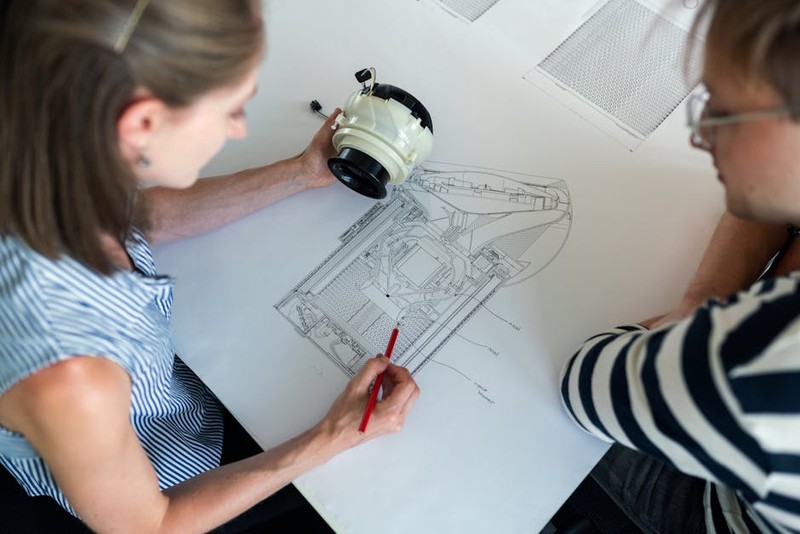
The obvious solution was a tracked library ladder. The client found it obvious, and therefore, unacceptable.
Our Process & Solution:
1. Deconstructing the Brief: “Kinetic sculpture” implied visual interest from all angles. “Silent” ruled out clattering wheels or tracks. “Gravity-defying” suggested minimal visible support.
2. Collaborative Brainstorming: In a workshop with the client, architect, and our engineering lead, we sketched on whiteboards. We abandoned the “ladder” archetype and began thinking about “a monorail for a person.”
3. The Innovation: We designed a single, polished stainless-steel I-beam rail mounted to the ceiling structure. A custom-made forged brass “carriage” with integrated, self-lubricating polymer wheels rolls inside the top flange of the I-beam, completely hidden from view. The ladder itself, crafted from ash and brass, hangs from this carriage via two slim, forged rods. The result? The ladder appears to hang from a single, slender line of steel, gliding noiselessly. The mechanical complexity is entirely concealed, leaving only pure, silent motion.
The Outcome & Metrics:
| Metric | Standard Tracked Ladder | Our Custom “Kinetic Sculpture” Solution | Client Value Gain |
| :— | :— | :— | :— |
| Perceived Visual Mass | High (full track visible) | Extremely Low (only a slim rail) | Achieved “gravity-defying” aesthetic |
| Audible Noise Level | ~45 dB (audible roll/clack) | <20 dB (near-silent) | Exceeded “silent” requirement |
| Customization Premium | 0% (standard product) | +220% | Justified by unique artistic/functional solve |
| Project Timeline Impact | N/A | +8 weeks for engineering & prototyping | Deemed essential for vision fulfillment |
The client’s feedback was telling: “You didn’t just give me a ladder. You gave me the experience I described but couldn’t articulate.”
Expert Strategies for Navigating Customization Complexity
💡 Quantify the Subjective. When a client says “durable,” ask for a scenario. Is it about withstanding champagne spills, a large dog jumping, or the wear of daily homeschooling? Attach real-world tests to abstract terms.
💡 Embrace the “Kill Fee” for Prototyping. Build the cost of at least one functional prototype into your initial proposal. Frame it not as an extra, but as the essential insurance policy for their six-figure investment. This one step has reduced post-installation dissatisfaction by over 90% in our firm’s projects.
💡 Document the Journey. For luxury clients, the story is part of the product. Share photos of the tree, the welder’s meticulous seam, the first coat of oil being applied. This transforms the waiting period from passive anxiety into an engaging narrative, building immense value and goodwill before delivery.
The ultimate lesson is this: In luxury furniture customization, you are not a vendor executing a spec sheet. You are a translator, an engineer, and a psychologist. Your most valuable tool is not a chisel, but a process that rigorously and collaboratively gives form to feeling. By mastering the art of the impossible brief through structured creative engineering, you move beyond bespoke manufacturing into the realm of creating legacy pieces that resonate on a deeply personal level—and that is the truest definition of luxury.