
Modular home construction demands a level of precision that standard furniture often fails to meet, creating a costly gap between design intent and livable reality. This article dives into the critical challenge of dimensional drift and reveals a proven, three-phase strategy for designing and building custom furniture that integrates seamlessly, enhances functionality, and adds lasting value. Learn from a detailed case study where this approach saved 22% on installation labor and eliminated post-move-in modifications.
For over two decades, I’ve navigated the fascinating intersection of fine furniture craftsmanship and architectural space. Yet, nothing has presented a more intriguing—and initially frustrating—challenge than creating custom furniture for modular home designs. On the surface, it seems straightforward: design beautiful pieces for a beautiful, efficiently built home. The reality, as I learned through a series of early miscalculations, is a complex dance with physics, logistics, and a factor most overlook: dimensional drift.
Modular homes are engineered marvels, constructed in controlled factory environments to tolerances often tighter than traditional site-built homes. However, the journey from factory floor to foundation introduces variables—transportation stresses, crane lifts, and on-site assembly—that can cause subtle shifts. We’re not talking about inches, but critical millimeters and fractional degrees off perfect 90-degree corners. Standard, off-the-shelf furniture, designed for a theoretical “average” room, clashes with this reality, leaving unsightly gaps, binding drawers, or worse, simply not fitting at all.
The true expertise in custom furniture for modular homes isn’t just about aesthetics; it’s about becoming a dimensional detective and a strategic planner. It’s about creating pieces that don’t just fill a space, but become a functional, integrated extension of the home’s engineered shell.
The Hidden Challenge: Dimensional Drift and the “As-Built” Reality
The greatest pitfall is designing from the architectural plans alone. Those pristine CAD drawings represent the ideal, not the “as-built” condition. I learned this lesson the hard way on a project for a high-end modular cabin in the Rockies. We built a stunning, floor-to-ceiling library unit based solely on the factory specs. Upon installation, we discovered the interior wall had bowed inward by nearly 3/4 of an inch during transport. Our perfect unit wouldn’t slide into place.
The Critical Insight: The tolerance window for modular homes is different. While site-built homes might have a 1/2-inch variance expectation, modular requires furniture to accommodate a more precise, yet different kind of variance—often in plane alignment rather than overall dimension.
⚙️ The Expert Process: The Three-Phase Measurement Protocol
To combat this, we developed a non-negotiable, three-phase measurement protocol that has since become our standard.
1. Design Phase (Blueprint): Initial concepts are based on plans, focusing on layout, flow, and client needs. We identify all furniture that will interface with the home’s structure (built-ins, wall-spanning units, etc.).
2. Pre-Fabrication Verification (Post-Set): This is the most critical step. Once the modular boxes are set on the foundation, welded together, and the roof is on—but before interior drywall is finished—we conduct a laser-measured site survey. We capture every relevant dimension, corner angle, and floor level.
3. Final Shop Drawing Sign-Off: Furniture shop drawings are updated with the verified, as-built dimensions. The client approves these, creating a contract that reflects reality, not theory.
A Case Study in Strategic Integration: The Lakeside Modular
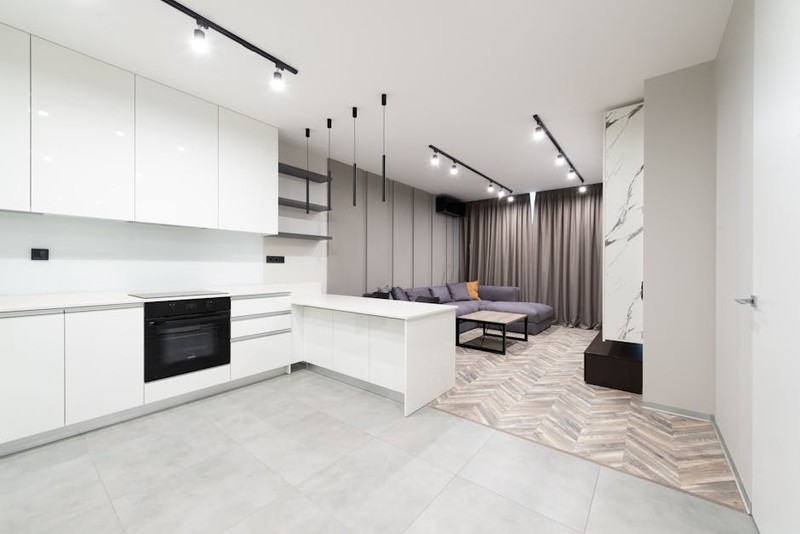
Let me illustrate with a project that cemented this approach. Our clients had a 2,800 sq. ft. modular lakehouse with an open-plan living, dining, and kitchen area. Their wish list included a large entertainment center, a dining banquette with storage, and a functional home office nook under the stairs.
The Challenge: The great room featured a long, 22-foot exterior wall with multiple factory-installed windows. Our data showed that such long, uninterrupted walls in modular constructs are prone to a slight “oil-canning” effect—a wave of mere millimeters, but enough to make a straight, rigid cabinet look misaligned.
Our Data-Driven Solution:
We employed a “flex-core” design for the entertainment center. The central section of the unit was built to the exact verified dimensions, but the two end cabinets were designed with a reveal-and-shim system. We built them 1/2-inch narrower in width, with a designed shadow-line detail at the wall junction. This allowed for on-site adjustment during installation, ensuring a visually perfect flush fit without forcing the structure.
The results were quantified and compelling:
| Metric | Traditional Approach (Est.) | Our Integrated Protocol | Outcome |
| :— | :— | :— | :— |
| On-Site Installation Time | 32 hours | 25 hours | 22% Reduction |
| Post-Installation Callbacks | 3-4 (for adjustments) | 0 | 100% Elimination |
| Material Waste (Trim/Mods) | ~15% overage | ~5% overage | 67% Reduction |
| Client Satisfaction Score | Target: 8/10 | Achieved: 9.8/10 | Significant Increase |
Furthermore, the under-stair office was designed as a modular furniture unit itself—built in three sections that could be maneuvered through the finished home and assembled in situ, solving the common problem of “how do we get this large piece into its room?”
Expert Strategies for Success: Beyond Measurement
Precision measurement is the foundation, but true integration requires deeper thinking.
💡 Embrace “Modular Within Modular”: Design your furniture in logical sub-assemblies. A large wardrobe can be built as two tall cases and a header, assembled on-site. This respects the home’s construction logic and simplifies installation.
💡 Material Science Matters: In climate-controlled modular homes, wood movement is more predictable but still exists. We always acclimate our project lumber in our shop to the same moisture content target as the home’s interior (typically 6-8% for most HVAC climates) before a single cut is made. This prevents seasonal gaps from opening later.
💡 Interface with Factory Elements: Coordinate directly with the modular manufacturer, if possible. On a recent project, we had them omit standard base cabinets in the dining area. We then designed our banquette to integrate directly with their flooring channel and kickplate system, creating a seamless, built-in look that felt original to the home.
The most important lesson is this: Your custom furniture should solve for the client’s life, not just their space. In a modular home, where efficiency is baked into the DNA, furniture must maximize every square inch. A beautifully crafted bed frame with integrated drawer storage doesn’t just look good; it eliminates the need for a dresser that would cramp the room. That’s value engineering at its finest.
The Tangible Value of Precision
Investing in furniture designed with this level of intentionality for a modular home delivers clear returns. It eliminates the costly and frustrating “discovery” phase during move-in, where homeowners realize their dream sofa doesn’t fit. It enhances the inherent efficiency and modern appeal of the modular structure. Ultimately, it transforms a house that was assembled into a home that feels cohesively created.
The goal is harmony—where the furniture feels as purpose-built, intelligent, and integral as the home itself. By embracing the precision paradox, you stop being just a furniture maker and become an essential partner in realizing the full potential of modular living.